
The logistics industry depends on people as much as it depends on vessels, trucks, aircraft, warehouses and technology. Yet across many parts of the global transport sector, a significant part of the potential workforce remains underrepresented.
Women account for only around 12% of the global transport and storage workforce, according to the World Bank. Their representation is even lower in several operational and technical occupations, despite logistics companies facing growing pressure to develop skilled workers, improve workforce resilience and prepare for more complex supply chains. A recent initiative in Sri Lanka provides a practical example of how this situation may gradually be changing.
From an Inclusion Initiative to Daily Operations
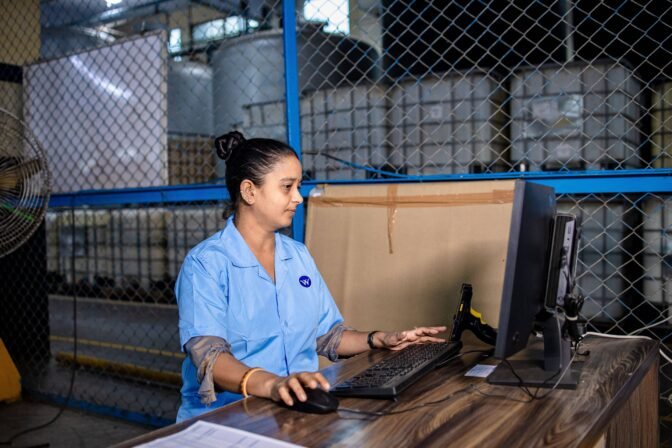
Aitken Spence Logistics, working with Maersk, introduced female forklift operators at its Container Freight Station in Sri Lanka. The initiative began in 2024 with eight young women and has since developed into part of the facility’s regular operations. The operators work inside a 100,000-square-foot Container Freight Station, performing roles traditionally associated almost entirely with male employees. The concept was inspired by Maersk India’s “Pink Warehouse” initiative and was later introduced to the Sri Lankan operation. The significance goes beyond the forklift itself.
Forklift operation is a visible example of a much larger issue facing logistics: whether recruitment continues to follow traditional assumptions about who performs particular jobs, or whether companies expand access based on training, capability and operational requirements.
Logistics Remains a Male-Dominated Industry
Transport and logistics continue to rank among the most male-dominated industries globally. World Bank research estimates that women represent approximately 12% of transportation and storage workers worldwide. The numbers vary significantly by subsector. Women represent around 5% of workers in land transport, 10% in water transport and 21% in warehousing and transportation-support activities. Aviation has a comparatively higher share, at approximately 38%. These figures show that the gap becomes particularly visible in operational parts of the supply chain.
Warehouses, terminals, trucking operations, ports and technical transport functions have historically attracted far fewer women than administrative, customer-service or office-based logistics positions. The challenge, therefore, is not simply increasing the overall number of women working in logistics.It is expanding access to the full range of jobs that exist across the supply chain.
Why This Is Also a Workforce Issue
Gender diversity is often discussed primarily as a social or corporate responsibility subject. For the logistics industry, however, there is also an operational dimension. Modern supply chains require skilled warehouse operators, equipment operators, planners, drivers, technicians, engineers, customs specialists, data analysts and managers. Limiting recruitment—directly or indirectly—to only part of the potential workforce can reduce the available talent pool.
The World Bank has identified greater female participation in transport as an opportunity to address labor shortages while improving team performance, innovation and service delivery. This becomes increasingly relevant as logistics operations become more sophisticated. Automation does not necessarily eliminate the need for workers. Instead, it changes the type of skills required.
Modern forklifts, warehouse-management systems, automated storage equipment, digital customs platforms and transport-management systems increasingly require trained operators who combine practical experience with technical capability. As equipment changes, some of the traditional assumptions surrounding physically demanding logistics jobs are also changing with it.
The Forklift Is Only One Example

The Sri Lankan initiative attracts attention because a woman operating heavy equipment inside a Container Freight Station challenges an established perception. But the broader opportunity extends much further. Women can increasingly participate across warehouse operations, inventory control, freight forwarding, customs coordination, transport planning, maritime operations, aviation logistics, supply-chain technology and management.
The International Labour Organization has similarly highlighted the importance of expanding women’s career and leadership opportunities throughout global supply chains. The long-term objective is therefore not to create isolated “female roles.” It is to make recruitment, training and career progression more dependent on competence and less dependent on assumptions about which jobs are traditionally performed by men or women.
Training Is More Important Than Symbolism
For initiatives like this to have lasting impact, recruitment alone is not enough. Operational logistics requires professional training. Forklift operators, for example, need equipment training, safety procedures, cargo-handling knowledge, spatial awareness and familiarity with warehouse or terminal operating rules. The same principle applies throughout transport. Successful workforce expansion requires companies to invest in training, appropriate workplace policies, safe working environments and realistic opportunities for career progression.
The World Bank identifies recruitment, retention, workplace policies, career advancement and leadership as key areas that must be addressed if transport companies want to expand women’s participation sustainably.Without these structures, diversity can remain a corporate statement.With them, it becomes workforce development.
A Wider Talent Pool for a More Complex Industry
Global logistics is becoming more demanding. Supply chains are dealing with geopolitical disruption, digitalization, automation, tighter delivery requirements and increasingly complex compliance environments. The industry’s response cannot depend only on additional infrastructure and technology. It also requires people. Opening operational and technical logistics careers to a broader workforce can give companies access to skills and talent that might otherwise remain outside the industry.
The Sri Lankan example is still relatively small: eight women entering forklift operations will not transform the global logistics workforce by itself. Its importance lies in what it demonstrates.Jobs traditionally viewed as unsuitable or inaccessible can become viable career paths when companies provide training, opportunity and the appropriate working environment.
Logistics Is Changing and Its Workforce Will Change With It
The future of logistics will be shaped by automation, artificial intelligence, advanced warehouses, new transport technologies and increasingly integrated global supply chains. But those systems will still require trained people to operate, manage and improve them. The question for the industry is therefore not simply how many women currently work in logistics. It is whether companies are making full use of the available workforce.
The introduction of female forklift operators in Sri Lanka represents one practical step toward answering that question. For an industry constantly searching for greater efficiency, resilience and skilled labor, widening access to operational careers is not only about inclusion. It is also about ensuring that logistics has the workforce it needs for the future.
Sources: The Sunday Times Sri Lanka, World Bank Group and International Labour Organization.